Saturday, June 21, 2008

Knitting with wit


Knitting.

It's cool again. Like bicycling, knitting has become associated with celebrity, and it is cool. Madonna's apron pattern is famous. Vanna White has an eponymous line of yarn, part of the profits of which go to charity. June 14 was Worldwide Knit in Public Day. In cities, knitters fan out at night to wrap public trees with small knitted scarves.

Since age 4, I have been a knitter. My mother taught me to knit using what I now know to be the Continental method. I like this method better than the English method, because both hands are equally involved in the process.

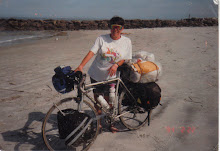
I find the repetitive nature of knitting soothing. On the other hand, my pulse rate quickens at the sight of multiple skeins of yarn in yarn shop. I love being able to create something unique. I like the fact that knitting is portable. (I even carried my knitting on my cross-country bicycle trip.)

A yarn shop in my town, Bryan, Texas, has a Friday evening "stitch and bitch" social time with no rules, no dues, just fun.

I taught myself to make socks, and for the past few months, socks are all that has come off my needles. Size is not usually a problem, as most women's feet fall into a small range; I can adjust gauge for a sock weight to bulky yarn; and they are just fun and a little challenging. Also, the bulky ones are practical for cooler days.

There is something so soothing about the repetitive motions of knitting and so satifying about the feel of the yarn, needles, and finished product.

Thursday, June 19, 2008

Bicycle commuting

For years, long before it was cool, during the time a young Lance Armstrong was first attempting triathlons in north central Texas, before Greg Lemond won even his first Tour de France, in fact, during the last days of Eddy Merckx's professional career, I have loved bicycles and bicycling. I especially like to commute to and from work by bicycle because it fulfills two goals: exercise and environmental responsibility. I started riding an internal-hub three-speed to my summer job while a college student in the late 1970s. (I still have that bicycle and use it for grocery shopping.)

My coworkers at my first "professional" job probably thought of me as that "girl on the bicycle," but were too polite to say so aloud. Similarly, a motorcycle-riding female computer scientist was defined as "the woman who rides a motorcycle."

With the higher profile and popularity of the Tour de France and bicycling's entry in the Summer Olympics in the 1980s, bicycling became more mainstream. Finally, I was, well, maybe quasi cool.

Then, a new Army general and avid cyclist came to lead the military base adjacent to the town. Bicycling became cool, very cool, and trendy, and chic and the "it" thing to do. Especially for gung-ho young military officers. I continued to draft behind the virtual peleton of cycling popularity, commuting to work (20 miles round trip at an average 12 mph), participating in recreational rides. The fun and convivial local bicycle club called itself the "ride to eat" club, with rides punctuated midway by a breakfast stop.

It's interesting to observe the viral spread of cycling popularity. At this point, I was a full-fledged bikie, but a woman from work, encouraged by another dyed-in-the-wool cyclist, amazed me by riding about 20 miles daily of unrelenting uphill from her home by the river to our work site on the flank of a mountain. Without a go-fast bicycle, without purpose-built cycling clothing, and perhaps without a clue that she was peforming an amazing physical feat on a daily basis.

While upgrading through a series of light road bikes, I joined group rides, large benefit rides, and organized a recreational bicycling club in my town. Gingerly, I started riding a mountain bike. A heavy-duty touring bike took me on several multiday tours and eventually a solo, self-contained cross-country trip.

Okay, now I'm in a different state, different atmosphere, different age. I have cut back to bicycle commuting and one organized ride per year. I find the recreational club in this town somewhat daunting. I still hold out hope for another cross-country expedition, maybe north to south this time.

Sunday, May 18, 2008

Working 101


Last month, the man who took a chance on a neophyte wannabe technical writer 28 years ago in Sierra Vista, Arizona, swung by the southeast Texas area with his wife in their recreational vehicle. Richard and Margie are full-time RVers, having sold their homestead and equestrian ranch in favor of criss-crossing the country in an RV towing a wood-carving shop, working at bed-and-breakfast one season, spending the summer at their secluded acreage the next.

Me, circa 1986 (left) in my badge photo. Richard today, in his RV (right).


They looked the same, truly. Richard, prematurely gray even back then, now white-haired, but with the same jovial sense of humor, same good heart. Margie, a horse wrangler, looking fit and trim and relaxed.

Reflecting about the three years I worked for Richard reminded me of the Mark Twain quotation: "When I was 16, I was shocked at how little my father knew; when I was 22, I was amazed how much he had learned in six years." At 22, I'm certain I was a difficult, opinionated, undiplomatic, awkward, unpoised recent college graduate. Like Twain's 16-year-old self, I thought perhaps not that I knew it all, but certainly more than the people I worked with. In retrospect, I would not have wanted to work for myself. I thought I knew a lot; I really knew nothing. I had no idea the difficulty of managing a technical writing section. Richard not only put up with a lot of stress induced by me—and several other of my motley bunch of coworkers—but, to his credit, held no hard feelings.

Thanks to the start Richard gave me more than a quarter-century ago, I've made all or part of my living as a technical writer since then. But even more important, after years in the graduate school of hard knocks, I view Richard's instruction in Working 101 as one of the best fundamental courses I have taken.

Friday, May 16, 2008

Original recipe for blackened tilapia Tajin

Tajin Fruit Seasoning, salsa en polvo. Powdered salsa. A seasoning for all seasons. It is intended to be sprinkled on fruit, but its piquant flavor is has much more potential.

As unlikely as it sounds, try--just try!--Tajin fruit seasoning sprinkled on strawberry ice cream. A synergistically phenomenal contrast of flavors.

Now, an original recipe from the kitchen of Waitress from Mensa:

Blackened Tilapia Tajin

4 tilapia fillets
3/4 cup flour
3 tablespoons Tajin fruit seasoning
1 tablespoon Italian seasoning
pinch nutmeg
1/2 teaspoon salt
1/2 teaspoon pepper
enough oil for pan frying

Toss flour, Tajin fruit seasoning, Italian seasoning, nutmeg, salt, and pepper with a fork.

Dredge tilapia fillets, both sides, in flour mixture. Fry in hot oil in a skillet, both sides, until fish flakes easily with fork.

Lime + chile: The taste will explode on your tongue; not hot, just flavorful.

Thursday, May 1, 2008

Breakin' up is a big to-do


My boyfriend, a wiry electrian (pun unintended), ended our our four-year relationship to pursue the fourth love of his life more than two years ago. (The first three partners did not work out.) Never could I have imagined that this decent, kind, forgiving, intelligent, analytical, and truthful man would treat me with such callousness. In that stationary moment, he became a stranger to me, full of lies and deceit and meanness. It was a messy thing, and he did not handle it well. Maybe I did not either.


Ultimately it is for the best, but my fundamental trust in my own perception of people is irreparably shaken.

Eventually, as one does, I came to terms with it, and moved on. In retrospect, it all makes sense now, but, of course, while in the relationship, in the moment, the signs are invisible.

Although marriage was never in the cards for us (in other words, in my tongue-in-cheek description, the relationship was not terminal, as in terminating in a marriage), he was the best and most respected of any beau in my 33 years of adult singlehood.

At this age, I feel relieved of the burden of worrying about marriage, or the fact that I've never been married. This is what it is. While in my earlier 30s, a dear friend said, "You might just be one of those people destined never to marry." Back then, I held out hope, but now I'm more "que sera" about it. (Thanks, Doris Day.)

Whenever I meet a lifelong bachelor of a certain age, though, I wonder what is wrong with him. But it does not occur to me that other people might be, understandably, raising the same questions about me. And are they right to wonder?

Even Jerry Seinfeld, before he was married, likened the idea of marriage to someone choosing a car, but with the imprimatur that you have to drive this one car for the rest of your life. Seinfeld is now married—to a possibly plagiarizing cookbook author—with whom he has three children. Of marriage, and alluding to the high divorce rate, someone wrote something to the effect that marriage was the triumph of hope prevailing over all rational thought and experience. We still do it, though.

Monday, July 2, 2007

The New

From the aunt

Carbon is the new smog. Brown is the new black. Tea is the new coffee. Kia is the new Hyundai. Geek is the new nerd. Fair market is the new free market. Cozumel is the new Acapulco. Asheville, N.C., is the new Fremont, Wash. Rap is the new rock. Local is the new global. Skateboards are the new in-line skates. (Note: In-line skates were the new skateboards two decades ago.) Green is the new eco. Eco-tourism is the new archeological dig vacation. All-inclusive resort is the new ocean cruise. Platinum is the new gold. Titanium is the new aluminum. Hemp the new cotton. Hormone-free is the new organic. Friends-with-benefits is the new significant other. Gmail is the new Yahoo mail. Flash drives are the new CDs. Orlando Blum is the new Richard Gere. Lindsay Lohan is the new Liza Minelli. Interdisciplinary is the new ivory tower. Drums are the new primal scream therapy. Anne Hathaway is the new Sandra Bullock. Crocs are the new jellies. China is the new Japan. Outsourcing is the new contracting. Bariatric surgery is the new lipsuction. Text messaging is the new IM. Starbucks is the new indoor mall.


From the niece

YouTube is the new TV, three-quarter pants on men are the new baggy jeans (that is my prediction! mark my words--it is coming)."Grey's Anatomy" is the new "ER," Bratz are the new Barbies, iPods/Zunes are the new CD players, emo is the new goth, computers are the new books, Dane Cook is the new Jerry Seinfeld, MySpace is the new (mall, hangout, chat room, idk?), abbreviations are the new slang.

Thursday, December 7, 2006

Out of context

Everyone has probably had the experience of making eye contact with an acquaintance, only to have that person quickly avert his or her gaze to avoid having to make social contact. Then both tacitly adopt the conceit that we did not really see each other.

Waitresses are people too. We do not evaporate up the fry hood after each shift. We shop for groceries, we walk our dogs, we stop in for coffee, we go to plays and concerts, we meet friends, we enjoy our hobbies.

Maybe I am particularly sensitive to this avoidance gesture, but I find it degrading, perhaps because it is weighted with presumptions of the (lack of) esteem in which service persons are held.

Once, while shopping for household items, I encountered a regular customer who previously had chatted me up virtually every evening for weeks after he was relocated to this town. Our eyes locked for a second as we pushed our carts. I smiled with an upbeat hello. He effected the avoidance move. He was with his wife (who had just moved here).

I expected him to, at a minimum, do the head bob of recognition. Optimal would be to introduce me to his wife. Instead, he pretended he did not see me.

Me, somewhat loudly: "Are you pretending you don't know me?" I was miffed. More than miffed.

I extended my hand and introduced myself to his wife, who was gracious.

At the cafe, this man had shared every manner of detail about his life: his bariatric surgery, his years of truck driving, his service as a volunteer firefighter, the series of events leading to his ownership of a lakeside vacation home, infinitestimal details of his new job at an oil company dispatch yard. Very friendly.

The man liked to talk. Definitely did not like to listen, ignoring me when I had the temerity to even offer a small comment here and there on the subject of his life. Outside the confines of cafe, when I could not function as the receptacle of his verbal outflow, apparently he did not feel any need to acknowledge me.

Of course, it's a reflection on him, not on me. But I'm still annoyed.

Thursday, November 23, 2006

The thin veneer

The cafe staff is composed almost exclusively people recovering from substance abuse. A rehab halfway house in our city furnished a steady stream of good workers. When one waitress came to the end of her stint at the rehab house, the boss asked her spread the word that a successor was needed. These folks were reliable, hard-working, and intelligent. Their stories of a tough life contrasted with my relatively sheltered life.

I found their resilience and resourcefulness humbling. It was a lesson in humility. I felt guilty about ever complaining about my lot in life.

Despite the fact that waiting tables has traditionally been the employment bastion of the uneducated, make no mistake, a good waitress possesses the skill set to be a corporate vice president. Given advantages early on in life, the career trajectory is limitless for a person with the interpersonal skills, multitasking abilities, and sheer physical rigor to wait tables, assuming they start from a position of strength.

A lot of unfulfilled potential. A lot. Sadly. These are people I respected.

Life, as with chemistry, where one ends up depends so much on where one starts, to paraphrase Barbara Ehrenreich, an experiential journalist (and cell biologist) who wrote about trying to get by on low-wage jobs in Nickel and Dimed: On (Not) Making it in America.

For my food service friends, life is a struggle: with finances, with the demons that beset them, with their families, against society's perception.

Years before, I visited with a homeless young man at the beach in San Diego. He had owned a successful business cleaning boat hulls in San Diego Harbor. Through a series of mishaps and beset by a drinking problem, he lost his business, tumbled through the tiers of desperation, until he found himself at the lowest rung of society: homeless, penniless, and out of options. How tenuous is our grasp on affluence and normalcy! The veneer is frighteningly thin.

Wednesday, November 22, 2006

A tale of two citizens

Until recently, the wealthiest man in town dropped in for lunch every day. He ordered the identical lunch every day. His regular employee companion ordered that same lunch. Every day. Once a different (perhaps unindoctrinated) minion ordered something different. We never saw that employee again. Coincidence? Who knows?

The businessman was a gentleman. Always left a big tip, treated the waitstaff with courtesy, forgave of the foibles and gaffes of a new waitress. Sometimes he brought family in the evenings. Whatever his reputation in business dealings, he was consistently kind to us.

Once, two months after I had moved back into a professional career, I encountered him and that same employee companion on a commuter flight. I greeted them both with a wink and a good morning, calling them by name. The businessman's greeting was genuinely charming and even effusive. His employee companion, whom I had served an equal number of times, asked, "Who is she?" The boss explained.

As one of the cooks noted, "He takes notice of the people around him."

Class act.

In contrast, a member of the board of regents of a huge state university system occasionally dined with two college-age nephews.

It was apparent that the three felt as if they were to the manor born. Never did they make eye contact; their manner was inconsiderate and brutish. I once served the young relatives their iced teas first, and before I could even place the second glass on the table, the man barked, "Where's my beer?"

Then he proceeded to entertain the young men (by design), another customer across the room and me (by accident of being within earshot) about how a woman, whom he named, "was a mess," and once "groped him under the table" at a formal banquet. Then he segued to regaling us in graphic detail and with heavy use of the vernacular of the configuration of a college football player's genitals, which he had apparently viewed in the team's locker room after a game.

Apparently this man gives his own spin to an F. Scott Fitzgerald observation, "The very rich are different from you and me." And apparently are bound by a very different set of rules.

Tuesday, November 21, 2006

Hon: The Waitress Prerogative

The unique nature of waitress:customer relationship allows—requires, even—the waitress to, well, take a certain liberty when addressing customers.

Hon.
Not honey.

Despite the apparent disparity of our stations in life, waitresses have an assumed familiarity with customers.

So I found myself asking the former president of a large, well known university and his distinguished-looking guest: "Care for some more coffee, hon?"

Taking all kinds of liberties. It's expected.