Sunday, December 7, 2008

Downtown Bryan, Texas, Art Deco


A decade ago, historic downtown Bryan, Texas, was a pastiche of excellent locally owned restaurants, an intriguing international import shop, an unfinished furniture store, several thrift shops, a homeless mission, but, more notably, a number of abandoned main-street style storefronts, some roofless, some boarded-up, others without even the dignity of plywood covering the gaping windows.


Today, downtown Bryan is a destination, a vibrant city center, with a monthly Friday evening gallery tour and live music attracting throngs of citizens and tourists. The import shot relocated to a gorgeous storefront, several new, and some upscale, restaurants have opened, there's a massage therapy studio, and a scattering of antique shops sitting cozily beside some very high-tech neighbors.


A bit longer than a decade ago, the City of Bryan procured a community block grant to refurbish the Hotel LaSalle, which converted from a derelict hulk into a charming inn.

A group of citizens worked hard to transform the old firehouse into the Children's Museum of the Brazos Valley. Old Bryan Marketplace hosted a tea room along with an Texas-eclectic antiques collection.

(The concrete reliefs are art deco details are from the First State Bank and Trust Building, downtown Bryan, Texas.)


I am crazy about art deco, and downtown Bryan offers some great examples. The tallest building in downtown and the most flamboyantly art deco is Varisco Building. Bottomland cotton farmer Biaggio Varisco, an Italian immigrant, so loved his adopted home that he changed his first name to Brazos, after the county and its river (Brazos de Dios). In some essential way, the Varisco Building resembles the Empire State Building in this photo taken at Empire State Building: 5th Avenue & 28th Street.

The Varisco Building now houses a Tier IV data center, offering data storage and disaster recovery services to corporations, mainly in the Houston area. Fibertown grew out of the location of a fiber trunk routed through downtown Bryan. Fibertown offers bandwidth management, "an advanced data center with backup power, a high-speed managed network, high-capability services, and high-security biometric and RF building controls." (aboutTown Press, October 2007). The Fibertown "campus" has expanded five historic downtown buildings.


Main Street, downtown Bryan, looking north, with the Varisco Building in the distance.

Friday, November 28, 2008

Humor in the office break room

Full disclosure: these two humorous exchanges took place several years ago in the break room of the Department of Agricultural Engineering.

First, four women co-workers chatting over lunch stopped their girltalk when a Middle Eastern graduate student entered to heat up his lunch.

I joked, "Adil, you are brave to come into the kitchen with all girls in here."

Another co-worker: "He's hungry!"

Adil, known for both his sense humor and his limited English proficiency, came right back with, "A hungry man is a brave man."

Of great concern to these agricultural engineers was nonpoint source pollution, or contaminants contained in runoff. (Point source pollution refers more to a outlet pipe from a factory, for instance. A Pakistani engineer who specialized in runoff from dairy feed lots mentioned that his brother was a proctologist.

"You see, we both deal with waste disposal."

A graduate student [now himself a professor]: "Yeah, but he is more into point source."

Friday, November 14, 2008

Clase de espaƱol

From mid-September to mid-October, I studied Spanish with an eclectic mix of classmates and a super-energetic instructor, Antonio Caraballo, in a non-credit course offered by the cultural outreach program of Texas A&M University's business college.

It was great fun, and I'm looking forward to the follow-on course. Our instructor, a native of Puerto Rico, was the epitome of an engaged instructor. Dodging an oversize podium while running back and forth to the whiteboard, acknowledging comments or questions with, "How interesting," then turning each into a mini-lesson.

No question, it seemed, was off-limits. When we were learning pronouns and noun genders, one unabashed undergraduate asked, "Is there a way to say 'girly-man'?"

Without missing a beat, our maestro darted around the hulking podium, whiteboard marker at the ready, "Yes, it is 'el ella,' the he-she," in the same enthusiastic, yet rational, instructional style as when someone asked about the syntax of direct objects.

The nonhomogenous mix of classmates enhanced the entire experience: two Turks, one Indian MBA student, several American undergraduates, a former college athlete, several writers and editors.

Our final exam—this was, after all, a non-credit fun course—was ordering dinner in Spanish at a Mexican restaurant, Los Cazadores. It was fun, dinner was excellent, the company entertaining. Los Cazadores is now my favorite Mexican restaurant ever.

Friday, November 7, 2008

Idiomatic expressions and the Chinese engineer

I am the coordinator of a graduate engineering program. The majority of students are international students, all of whom speak have high English proficiency. Occasionally, though, the odd idiomatic phrase trips them up.

Part of my job is organizing each semester's seminar series, in which experts are brought in to talk about their research in a classroom setting. The last slide of most presentations is usually acknowledgment of the presenter's colleagues. The most recent presenter, an age 50+ New Yorker, titled his slide listing those names in a more casual than usual manner: "I get by with a little help from my friends."

A Chinese student, probably younger than age 30, asked me the meaning of that phrase. Simple enough, right?

So I started, "Remember the Beatles?" He looked puzzled, but nodded. He was probably thinking, "What the heck would the Beatles have to do with electromigration and integrated circuit design?" But he was a good sport.

"They sang a song called 'With a Little Help from my Friends." I sang some of the lyrics. (From the Sgt. Pepper Lonely Hearts Club Band album of 1967.)

Ooookay, but I still have not explained the concept.

"'To get by' means to just barely . . . just pass with the minimum requirements. " I said, digging myself into a deeper hole. "The phrase means his friends help him make his way through life. The speaker was making a casual reference in his ackowledgments.

Such a simple sentence, but it requires a knowledge of the tone of an entire era; perhaps the meaning cannot be conveyed across both two generations, a cultural barrier, and an ocean.

Saturday, November 1, 2008

Bore: someone who deprives you of solitude without offering companionship

A bore is someone who deprives you of solitude without offering companionship. (Oscar Wilde)

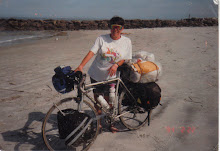
Several years ago, I published an essay in the Houston Chronicle's Texas magazine, a vignette of my night in Langtry, Texas, on my cross-country bicycle trip. Several people wrote me as a result, and one, a Houston CPA, asked me to dinner when he visited my city on business.

We met for dinner—me coming directly from work, him from a client's office—we agreed upon an Asian restaurant near the university whose parking is all in a metered lot. I warned him to bring some change.

He arrived a little late, seemingly surprised and annoyed, he said "All I can find are metered spaces, and I don't have any change."

I offered him some quarters, saying "I thought I mentioned the metered spaces."

He said, "You probably did; I was not listening," and refused my offer. He also said he pretty much ignored the [detailed and accurate] directions I sent via e-mail.

He turned down my offer of change and instead left and let me sit in the restaurant alone for 20 minutes while he found an unmetered spot. I thought of leaving after 15 minutes, but instead tried to give him the benefit of the doubt.

So, both my e-mail and my friendly advice on the telephone call were both ignored, and he makes me wait alone in a restaurant for 20 minutes while he seeks out a free parking space?

And he "talks long." We did not exit the restaurant until 9:30 p.m., although we met right after work. Maybe he is lonely. Despite its long length, I felt the conversation never "took off," and certainly there was no chemistry. Then it turns out his big hobby is having his photo taken with celebrities. I thought this was a bit odd. He said he graduated to this as asking for autographs was too juvenile. Ahem!

Fast-forward to last week. He again announces, via e-mail, that he will be in town to audit the same clients, and invites me to dinner. And although I don't have many dates, yet another 2.5-hour dinner listening to this man is not in the cards.

Saturday, October 4, 2008

House ache

My house is ill. It needs the attention of a number of specialists. And time and a lot of money. In fact, a minimum of half the original cost of the house itself.

It is a World War II-era pier-and-beam frame structure with an interesting facade of faux-limestone formed from concrete. It's a shotgun house with hardwood floors and ceiling fans and a cute built-in triangular corner china hutch. There is a one-car garage and a large separate outbuilding for storage, laundry, and workshop. A yard with my vegetable garden and patio. Easy bicycling and even walking distance from my job. Conveniently located. Good neighbors. Quiet neighborhood.

The foundation is sagging. The entire floor, including the 60-year-old hardwood floors (they cannot be salvaged), will be sawn out and removed down to the earth, and new joists inserted underneath. A subfloor will be laid. After that, another specialist or perhaps three will lay the actual floor: new hardwood, or tile, or whatever else I might find. Then new window frames, maybe a roof, and definitely a fence. The rooms I painted might need to be repainted.

To add to the upheaval, I will have to pack up everything and actually move out of my house. All of the occurs during the hectic academic year, not in summer. I plan to move most of my stuff into my garage, and just take the necessities to a temporary apartment.

My boss, who apparently thinks that my time 24/7 belongs to my job (even balking at signing an external employment request for my four hours per week of freelance editing on weekends)
has not responded to my e-mail asking for approval of some vacation time to take care of this business, and just weekends do not give me enough time.

Of course, things could be worse. I live within my means, my mortgage payment is tiny, and I'm in no danger of losing my house. My heart goes out to people foreclosed out of their homes due to bad information from greedy mortgage companies. Still, without the home equity loan necessary to fund this work, the mortgage on my little house would have been retired in a bit more than a year.

Sunday, September 28, 2008

Debra Ginsberg, author and former waitress

During my waitress days, a friend brought to my attention Debra Ginsberg's book Waiting: The True Confessions of a Waitress. It was on the staff-recommended table at Borders and was further recommended by the "fun and unconventional" cafe workers there. Although Debra Ginsberg had much more extensive experience--and therefore memoir-able anecdotes--waiting tables than did I, her tales resonated just enough that I felt the typical "oh, yeah" connection that any two people in the same line of work implicitly feel. But there are other commonalities: we share the same religion and birth city and are about the same age, and we had both worked at National Park concessions during youthful summers. The only difference: I loved it being in the National Parks; Debra Ginsberg, did not, for reasons described in the book.

Books by Debra Ginsberg
Debra Ginsberg has published four books since then, and at least one article in a national women's magazine. I've fallen behind on reading, just recently purchasing, then relishing the giddy anticipation of the dish of Blind Submission, the story of an aide to a high-powered, ethics-challenging literary agent. I'm really looking forward to the memoirs Raising Blaze, about raising her autistic child as a single mother and About My Sisters , of the bonds between the sisters within an unconventional family. The most recent book is The Grift about a pseudo-psychic whose life is complicated by the attainment of genuine psychic powers and the chance of romance from a past client in a past life.

Debra Ginsberg and a fan
After marveling at convergences in our histories, in 2005, I took a deep breath and wrote an e-mail. Ms. Ginsberg replied with a long and eloquent response, not as published author to fan, but, more as peer to peer. She spoke a bit of the life of a writer and author, but also about the similarities between all women of our generation.

Ms. Ginsberg said my e-mail made her day, as did hers mine, several-fold.

Debra Ginsberg, best wishes for your continued success.

Sunday, September 21, 2008

Deep in the Heart of Excess

In 1974, Marcia Seligson published a treatise on nuptials entitled The Eternal Bliss Machine: The American Way of Wedding. Appropriately, the chapter on a Dallas wedding was called "Deep in the Heart of Excess." The conspicuous consumption, gluttony, frenzied attention to the minutest of detail was surreal.

In my weddings-to-remember history, one reception that stands out was the wedding of two co-workers, just acquaintances, at a rather run-down swim-and-tennis club in Las Vegas. Everyone from the company piled into vehicles for the 7-hour drive from southeast Arizona to Las Vegas for the festivities. Although the annual cost of the day-to-day wardrobe and grooming supplies of the high-maintenance bride seemed to rival the GDP of a small country, the wedding was decidedly casual.

The invitations advised packing swimsuits and athletic clothing. This was a departure! The low-key ceremony took place poolside, with the couple standing at the large 6' mark painted on pool tiles. Minutes after the big kiss, the groom announced, "Let's play," and play we did.

We rushed into the locker room, changed into athletic clothing and hit the tennis courts, volleyball sand, and basketball courts. Some people swam, others danced. There must have been a buffet-type dinner, but it's lost to memory. What I do remember was FUN! Lots of hard-hit balls from the baseline in tennis, kids running around, a lively beach volleyball game, the de rigeur event of a boss (and probably the groom, as well) being thrown into the pool, classic rock music. How fun was that! Now that was a wedding to remember!

A dear friend is now planning a small, intimate wedding for Spring at the Antique Rose Emporium. Today we visited a bridal fair in College Station, Texas. The preponderance of options for the bride-to-be was overwhelming. A myriad of photographers (and videographers), florists, bridal dress shops (with the requisite ugly bridesmaids dresses), bakers, caterers, wedding invitation printers, event planners of all stripes and sentiments, estheticians, a harpist, chocolatiers, and even a clinical psychologist promoting a new State of Texas-approved prenuptial counseling option...and venues-venues-venues! I am amazed these twin cities of just over 120,000 population can support this many gazebos, pavilions, chapels, tents, halls, rooms, country clubs, and B&Bs.

Even my friend and bride-to-be, taking her cues from a book about planning a small wedding, seemed entranced. A chemist, even her logical scientific sensibilities seem overwhelmed by the blitz of options for even a small wedding.

Of course, who isn't impressed by the pageantry of an elaborate wedding? But I think back to that long-ago play day, in its ease and fun, and wonder when the pendulum might shift back to a simpler time and the extinction of the bridezilla. Maybe tough economic times will bring the simpler affair back into vogue.

Sunday, August 10, 2008

Word (processing) nerd

On to electronic word processing hints and tips. My thesis clients know this one. There is never a need to put more than one contiguous space in a Microsoft Word document. Any questions? Leave them in the comments; I will reply.

A couple of other word processing tips. You are the master of your fate on the following:


  • Precisely setting the vertical space after a paragraph. There are other options besides two carriage returns. (Handy when trying to fit a transmittal letter on one page.)

  • You can change the character, size and display of bulleted text. You don't need to accept the blobby round default. I like to use a small square in a one typeface size smaller than the rest of the text. For fun, you can use a character from the symbol set, webdings, wingdings, or even choose a picture.

  • You can also control the alignment of the wrapped lines of text. Don't insert a hard return and tab each line. Use a hanging indent.

  • Set tabs precisely where you want them. Clear the extraneous intervening tabs. If you want text to appear at 4 inches from the margin, set a tab at 4 inches, and clear the others. Don't merely tab-tab-tab until finally arriving exhausted and disheveled in the proximity of the desired point.

  • Likewise, set precise page breaks; do not insert hard returns ad nauseum until the software forces a soft page break. If you end up deleting or inserting something above, your page breaks can shift.

  • If you are aligning text with tabs, such the in the educational preparation in a curriculum vitae (CV), a clean way to keep, say, degree, university, and major neatly together is to create a table, adjust the column widths to your purposes, enter the data, then make the table invisible by hiding grid lines. You might also have to set borders to none (Format->Borders and shading->none.) Adjust the padding, if desired, using Table->Properties->Cell->Options. I almost always use zero.

  • Among others, there are decimal and right align tabs. Decimal tabs align the decimal point in a column of numbers. (Never use a left tab, then attempt to align decimal points with multiple spaces.)
    If you want to right align numbers, such as the page numbers in a table of contents, use right tabs, and, as always, clear extraneous tabs.

  • In technical papers, I keep the figures and their captions together by creating an invisible (see above) 1X2 (1-column, 2-row) table, and place the figure in the top cell, the caption in the bottom cell, setting cell margins to preference (Table->Properties->Cell->Options).

The Grammar Stickler

When it comes to written technical communication, after 25 years' work as a technical editor, I'm a stickler for punctuation, usage, grammar, expression of units of measure, logical organization.

Not so strict am I on spoken communication; in fact, the regionalisms which make other editors cringe I find delightful and amusing. A favorite East Texas quirk is the use of the present, instead of past, tense. (He run a V-8 Ford. They come south from Tennessee in 1930.)

And I never adhere to the stilted-sounding, "He is taller than I [am]." I've even been known to use a preposition to end a sentence with in colloquial spoken English.

Grammar Girl, what do you think of all this?

But, logically, English really needs a second-person plural pronoun to correlate with vous in French, and Ustedes in Spanish. Okay, OED, Texas has solved the problem. I'm talking about y'all. So much more elegant than the Brooklyn you guys, or the misguided youse guys, so much more efficient that you people. What do Midwesterners use? I'd like to know, ubetcha.

Another word to add to the lexicon: ain't. We say I am not. For the contraction, we say I'm not, not I amn't. And inverted for the interrogative, it becomes Aren't I?

Solution: I propose ain't as the contraction for am not. The machine stenography language used by court reporters has a code for ain't. Ain't it logical that written English should follow suit?

A couple of very common errors. In my experience, the most commonly misspelled word is accommodation. Notice that the root is the same as that of commode.

Imply/infer: Infer is not a fancy way of saying imply. The speaker implies; the listener infers.

Compose/comprise: A whole comprises (not is comprised of) its parts. Parts compose the whole.

Fewer/less: If an amount is quantifiable, a smaller amount is denoted as fewer, not less. For instance. "He has enjoyed fewer than 25 lattes in this Starbucks." If the amount is more bulk-y in nature, less is fine: There's less whip on this specialty drink today than last week."

Continual/continuous: Continual has more of a recurring connotation, while continuous means uninterrupted.

Decimate literally means to reduce by one-tenth, not to obliterate, but "its English meaning has been intended to include the destruction of any large proportion of a group." [Webster's II New College Dictionary]

Segueing into spelling out of numbers. In ordinary text, according to the venerable Chicago Manual of Style, numbers one through ninety-nine are spelled out, as well as any number followed by "hundred, thousand, million, etc."

On the other hand, in technical text, depending on the style of the journal, usually numbers 10 and below are spelled out when not denoting units of measure. Units of measure are always spelled out. Beginning a sentence with a number above 10? Recast the sentence to avoid the problem entirely in technical writing.

Engineers and physicists know this one. If a unit of measure is less than one, a zero precedes the decimal point (0.3 kilometers), but not if the unit is never expressed as other than a fraction, such as some statistical terms. The reason for the zero: to take the place of an integer (and maybe to assure readers that the integer was not unintentionally omitted.)

Hyphen, en-dash, em-dash: A hyphen, simply puts, makes one word out of two (high-flying acrobat). An en-dash (alt+numpad 0150)usually expresses an time interval (serving as president from 2000–2005). An em-dash (alt+numpad 0151), which has no spaces before or after, usually serves to set off a parenthetical: His Colonial-era farmhouse—built as a munitions depot—was in need of repair. It can also introduce a bulleted list, serving a similiar function to that of a colon.

Years of experience and months of pregnancy or anything that is a measure of something is expressed as a possessive: eight months' pregnant; 15 years' experience. (Note that these are plural possessives.)

Any editors out there have other observations to share? I would love to compile and include in a future entry.

Next time, some word processing tips.