My house is ill. It needs the attention of a number of specialists. And time and a lot of money. In fact, a minimum of half the original cost of the house itself.
It is a World War II-era pier-and-beam frame structure with an interesting facade of faux-limestone formed from concrete. It's a shotgun house with hardwood floors and ceiling fans and a cute built-in triangular corner china hutch. There is a one-car garage and a large separate outbuilding for storage, laundry, and workshop. A yard with my vegetable garden and patio. Easy bicycling and even walking distance from my job. Conveniently located. Good neighbors. Quiet neighborhood.
The foundation is sagging. The entire floor, including the 60-year-old hardwood floors (they cannot be salvaged), will be sawn out and removed down to the earth, and new joists inserted underneath. A subfloor will be laid. After that, another specialist or perhaps three will lay the actual floor: new hardwood, or tile, or whatever else I might find. Then new window frames, maybe a roof, and definitely a fence. The rooms I painted might need to be repainted.
To add to the upheaval, I will have to pack up everything and actually move out of my house. All of the occurs during the hectic academic year, not in summer. I plan to move most of my stuff into my garage, and just take the necessities to a temporary apartment.
My boss, who apparently thinks that my time 24/7 belongs to my job (even balking at signing an external employment request for my four hours per week of freelance editing on weekends)
has not responded to my e-mail asking for approval of some vacation time to take care of this business, and just weekends do not give me enough time.
Of course, things could be worse. I live within my means, my mortgage payment is tiny, and I'm in no danger of losing my house. My heart goes out to people foreclosed out of their homes due to bad information from greedy mortgage companies. Still, without the home equity loan necessary to fund this work, the mortgage on my little house would have been retired in a bit more than a year.
Saturday, October 4, 2008

Sunday, September 28, 2008
Debra Ginsberg, author and former waitress
During my waitress days, a friend brought to my attention Debra Ginsberg's book Waiting: The True Confessions of a Waitress. It was on the staff-recommended table at Borders and was further recommended by the "fun and unconventional" cafe workers there. Although Debra Ginsberg had much more extensive experience--and therefore memoir-able anecdotes--waiting tables than did I, her tales resonated just enough that I felt the typical "oh, yeah" connection that any two people in the same line of work implicitly feel. But there are other commonalities: we share the same religion and birth city and are about the same age, and we had both worked at National Park concessions during youthful summers. The only difference: I loved it being in the National Parks; Debra Ginsberg, did not, for reasons described in the book.
Books by Debra Ginsberg
Debra Ginsberg has published four books since then, and at least one article in a national women's magazine. I've fallen behind on reading, just recently purchasing, then relishing the giddy anticipation of the dish of Blind Submission, the story of an aide to a high-powered, ethics-challenging literary agent. I'm really looking forward to the memoirs Raising Blaze, about raising her autistic child as a single mother and About My Sisters , of the bonds between the sisters within an unconventional family. The most recent book is The Grift about a pseudo-psychic whose life is complicated by the attainment of genuine psychic powers and the chance of romance from a past client in a past life.
Debra Ginsberg and a fan
After marveling at convergences in our histories, in 2005, I took a deep breath and wrote an e-mail. Ms. Ginsberg replied with a long and eloquent response, not as published author to fan, but, more as peer to peer. She spoke a bit of the life of a writer and author, but also about the similarities between all women of our generation.
Ms. Ginsberg said my e-mail made her day, as did hers mine, several-fold.
Debra Ginsberg, best wishes for your continued success.
Books by Debra Ginsberg
Debra Ginsberg has published four books since then, and at least one article in a national women's magazine. I've fallen behind on reading, just recently purchasing, then relishing the giddy anticipation of the dish of Blind Submission, the story of an aide to a high-powered, ethics-challenging literary agent. I'm really looking forward to the memoirs Raising Blaze, about raising her autistic child as a single mother and About My Sisters , of the bonds between the sisters within an unconventional family. The most recent book is The Grift about a pseudo-psychic whose life is complicated by the attainment of genuine psychic powers and the chance of romance from a past client in a past life.
Debra Ginsberg and a fan
After marveling at convergences in our histories, in 2005, I took a deep breath and wrote an e-mail. Ms. Ginsberg replied with a long and eloquent response, not as published author to fan, but, more as peer to peer. She spoke a bit of the life of a writer and author, but also about the similarities between all women of our generation.
Ms. Ginsberg said my e-mail made her day, as did hers mine, several-fold.
Debra Ginsberg, best wishes for your continued success.
Sunday, September 21, 2008
Deep in the Heart of Excess
In 1974, Marcia Seligson published a treatise on nuptials entitled The Eternal Bliss Machine: The American Way of Wedding. Appropriately, the chapter on a Dallas wedding was called "Deep in the Heart of Excess." The conspicuous consumption, gluttony, frenzied attention to the minutest of detail was surreal.
In my weddings-to-remember history, one reception that stands out was the wedding of two co-workers, just acquaintances, at a rather run-down swim-and-tennis club in Las Vegas. Everyone from the company piled into vehicles for the 7-hour drive from southeast Arizona to Las Vegas for the festivities. Although the annual cost of the day-to-day wardrobe and grooming supplies of the high-maintenance bride seemed to rival the GDP of a small country, the wedding was decidedly casual.
The invitations advised packing swimsuits and athletic clothing. This was a departure! The low-key ceremony took place poolside, with the couple standing at the large 6' mark painted on pool tiles. Minutes after the big kiss, the groom announced, "Let's play," and play we did.
We rushed into the locker room, changed into athletic clothing and hit the tennis courts, volleyball sand, and basketball courts. Some people swam, others danced. There must have been a buffet-type dinner, but it's lost to memory. What I do remember was FUN! Lots of hard-hit balls from the baseline in tennis, kids running around, a lively beach volleyball game, the de rigeur event of a boss (and probably the groom, as well) being thrown into the pool, classic rock music. How fun was that! Now that was a wedding to remember!
A dear friend is now planning a small, intimate wedding for Spring at the Antique Rose Emporium. Today we visited a bridal fair in College Station, Texas. The preponderance of options for the bride-to-be was overwhelming. A myriad of photographers (and videographers), florists, bridal dress shops (with the requisite ugly bridesmaids dresses), bakers, caterers, wedding invitation printers, event planners of all stripes and sentiments, estheticians, a harpist, chocolatiers, and even a clinical psychologist promoting a new State of Texas-approved prenuptial counseling option...and venues-venues-venues! I am amazed these twin cities of just over 120,000 population can support this many gazebos, pavilions, chapels, tents, halls, rooms, country clubs, and B&Bs.
Even my friend and bride-to-be, taking her cues from a book about planning a small wedding, seemed entranced. A chemist, even her logical scientific sensibilities seem overwhelmed by the blitz of options for even a small wedding.
Of course, who isn't impressed by the pageantry of an elaborate wedding? But I think back to that long-ago play day, in its ease and fun, and wonder when the pendulum might shift back to a simpler time and the extinction of the bridezilla. Maybe tough economic times will bring the simpler affair back into vogue.
In my weddings-to-remember history, one reception that stands out was the wedding of two co-workers, just acquaintances, at a rather run-down swim-and-tennis club in Las Vegas. Everyone from the company piled into vehicles for the 7-hour drive from southeast Arizona to Las Vegas for the festivities. Although the annual cost of the day-to-day wardrobe and grooming supplies of the high-maintenance bride seemed to rival the GDP of a small country, the wedding was decidedly casual.
The invitations advised packing swimsuits and athletic clothing. This was a departure! The low-key ceremony took place poolside, with the couple standing at the large 6' mark painted on pool tiles. Minutes after the big kiss, the groom announced, "Let's play," and play we did.
We rushed into the locker room, changed into athletic clothing and hit the tennis courts, volleyball sand, and basketball courts. Some people swam, others danced. There must have been a buffet-type dinner, but it's lost to memory. What I do remember was FUN! Lots of hard-hit balls from the baseline in tennis, kids running around, a lively beach volleyball game, the de rigeur event of a boss (and probably the groom, as well) being thrown into the pool, classic rock music. How fun was that! Now that was a wedding to remember!
A dear friend is now planning a small, intimate wedding for Spring at the Antique Rose Emporium. Today we visited a bridal fair in College Station, Texas. The preponderance of options for the bride-to-be was overwhelming. A myriad of photographers (and videographers), florists, bridal dress shops (with the requisite ugly bridesmaids dresses), bakers, caterers, wedding invitation printers, event planners of all stripes and sentiments, estheticians, a harpist, chocolatiers, and even a clinical psychologist promoting a new State of Texas-approved prenuptial counseling option...and venues-venues-venues! I am amazed these twin cities of just over 120,000 population can support this many gazebos, pavilions, chapels, tents, halls, rooms, country clubs, and B&Bs.
Even my friend and bride-to-be, taking her cues from a book about planning a small wedding, seemed entranced. A chemist, even her logical scientific sensibilities seem overwhelmed by the blitz of options for even a small wedding.
Of course, who isn't impressed by the pageantry of an elaborate wedding? But I think back to that long-ago play day, in its ease and fun, and wonder when the pendulum might shift back to a simpler time and the extinction of the bridezilla. Maybe tough economic times will bring the simpler affair back into vogue.
Sunday, August 10, 2008
Word (processing) nerd
On to electronic word processing hints and tips. My thesis clients know this one. There is never a need to put more than one contiguous space in a Microsoft Word document. Any questions? Leave them in the comments; I will reply.
A couple of other word processing tips. You are the master of your fate on the following:
A couple of other word processing tips. You are the master of your fate on the following:
- Precisely setting the vertical space after a paragraph. There are other options besides two carriage returns. (Handy when trying to fit a transmittal letter on one page.)
- You can change the character, size and display of bulleted text. You don't need to accept the blobby round default. I like to use a small square in a one typeface size smaller than the rest of the text. For fun, you can use a character from the symbol set, webdings, wingdings, or even choose a picture.
- You can also control the alignment of the wrapped lines of text. Don't insert a hard return and tab each line. Use a hanging indent.
- Set tabs precisely where you want them. Clear the extraneous intervening tabs. If you want text to appear at 4 inches from the margin, set a tab at 4 inches, and clear the others. Don't merely tab-tab-tab until finally arriving exhausted and disheveled in the proximity of the desired point.
- Likewise, set precise page breaks; do not insert hard returns ad nauseum until the software forces a soft page break. If you end up deleting or inserting something above, your page breaks can shift.
- If you are aligning text with tabs, such the in the educational preparation in a curriculum vitae (CV), a clean way to keep, say, degree, university, and major neatly together is to create a table, adjust the column widths to your purposes, enter the data, then make the table invisible by hiding grid lines. You might also have to set borders to none (Format->Borders and shading->none.) Adjust the padding, if desired, using Table->Properties->Cell->Options. I almost always use zero.
- Among others, there are decimal and right align tabs. Decimal tabs align the decimal point in a column of numbers. (Never use a left tab, then attempt to align decimal points with multiple spaces.)
If you want to right align numbers, such as the page numbers in a table of contents, use right tabs, and, as always, clear extraneous tabs. - In technical papers, I keep the figures and their captions together by creating an invisible (see above) 1X2 (1-column, 2-row) table, and place the figure in the top cell, the caption in the bottom cell, setting cell margins to preference (Table->Properties->Cell->Options).
The Grammar Stickler
When it comes to written technical communication, after 25 years' work as a technical editor, I'm a stickler for punctuation, usage, grammar, expression of units of measure, logical organization.
Not so strict am I on spoken communication; in fact, the regionalisms which make other editors cringe I find delightful and amusing. A favorite East Texas quirk is the use of the present, instead of past, tense. (He run a V-8 Ford. They come south from Tennessee in 1930.)
And I never adhere to the stilted-sounding, "He is taller than I [am]." I've even been known to use a preposition to end a sentence with in colloquial spoken English.
Grammar Girl, what do you think of all this?
But, logically, English really needs a second-person plural pronoun to correlate with vous in French, and Ustedes in Spanish. Okay, OED, Texas has solved the problem. I'm talking about y'all. So much more elegant than the Brooklyn you guys, or the misguided youse guys, so much more efficient that you people. What do Midwesterners use? I'd like to know, ubetcha.
Another word to add to the lexicon: ain't. We say I am not. For the contraction, we say I'm not, not I amn't. And inverted for the interrogative, it becomes Aren't I?
Solution: I propose ain't as the contraction for am not. The machine stenography language used by court reporters has a code for ain't. Ain't it logical that written English should follow suit?
A couple of very common errors. In my experience, the most commonly misspelled word is accommodation. Notice that the root is the same as that of commode.
Imply/infer: Infer is not a fancy way of saying imply. The speaker implies; the listener infers.
Compose/comprise: A whole comprises (not is comprised of) its parts. Parts compose the whole.
Fewer/less: If an amount is quantifiable, a smaller amount is denoted as fewer, not less. For instance. "He has enjoyed fewer than 25 lattes in this Starbucks." If the amount is more bulk-y in nature, less is fine: There's less whip on this specialty drink today than last week."
Continual/continuous: Continual has more of a recurring connotation, while continuous means uninterrupted.
Decimate literally means to reduce by one-tenth, not to obliterate, but "its English meaning has been intended to include the destruction of any large proportion of a group." [Webster's II New College Dictionary]
Segueing into spelling out of numbers. In ordinary text, according to the venerable Chicago Manual of Style, numbers one through ninety-nine are spelled out, as well as any number followed by "hundred, thousand, million, etc."
On the other hand, in technical text, depending on the style of the journal, usually numbers 10 and below are spelled out when not denoting units of measure. Units of measure are always spelled out. Beginning a sentence with a number above 10? Recast the sentence to avoid the problem entirely in technical writing.
Engineers and physicists know this one. If a unit of measure is less than one, a zero precedes the decimal point (0.3 kilometers), but not if the unit is never expressed as other than a fraction, such as some statistical terms. The reason for the zero: to take the place of an integer (and maybe to assure readers that the integer was not unintentionally omitted.)
Hyphen, en-dash, em-dash: A hyphen, simply puts, makes one word out of two (high-flying acrobat). An en-dash (alt+numpad 0150)usually expresses an time interval (serving as president from 2000–2005). An em-dash (alt+numpad 0151), which has no spaces before or after, usually serves to set off a parenthetical: His Colonial-era farmhouse—built as a munitions depot—was in need of repair. It can also introduce a bulleted list, serving a similiar function to that of a colon.
Years of experience and months of pregnancy or anything that is a measure of something is expressed as a possessive: eight months' pregnant; 15 years' experience. (Note that these are plural possessives.)
Any editors out there have other observations to share? I would love to compile and include in a future entry.
Next time, some word processing tips.
Not so strict am I on spoken communication; in fact, the regionalisms which make other editors cringe I find delightful and amusing. A favorite East Texas quirk is the use of the present, instead of past, tense. (He run a V-8 Ford. They come south from Tennessee in 1930.)
And I never adhere to the stilted-sounding, "He is taller than I [am]." I've even been known to use a preposition to end a sentence with in colloquial spoken English.
Grammar Girl, what do you think of all this?
But, logically, English really needs a second-person plural pronoun to correlate with vous in French, and Ustedes in Spanish. Okay, OED, Texas has solved the problem. I'm talking about y'all. So much more elegant than the Brooklyn you guys, or the misguided youse guys, so much more efficient that you people. What do Midwesterners use? I'd like to know, ubetcha.
Another word to add to the lexicon: ain't. We say I am not. For the contraction, we say I'm not, not I amn't. And inverted for the interrogative, it becomes Aren't I?
Solution: I propose ain't as the contraction for am not. The machine stenography language used by court reporters has a code for ain't. Ain't it logical that written English should follow suit?
A couple of very common errors. In my experience, the most commonly misspelled word is accommodation. Notice that the root is the same as that of commode.
Imply/infer: Infer is not a fancy way of saying imply. The speaker implies; the listener infers.
Compose/comprise: A whole comprises (not is comprised of) its parts. Parts compose the whole.
Fewer/less: If an amount is quantifiable, a smaller amount is denoted as fewer, not less. For instance. "He has enjoyed fewer than 25 lattes in this Starbucks." If the amount is more bulk-y in nature, less is fine: There's less whip on this specialty drink today than last week."
Continual/continuous: Continual has more of a recurring connotation, while continuous means uninterrupted.
Decimate literally means to reduce by one-tenth, not to obliterate, but "its English meaning has been intended to include the destruction of any large proportion of a group." [Webster's II New College Dictionary]
Segueing into spelling out of numbers. In ordinary text, according to the venerable Chicago Manual of Style, numbers one through ninety-nine are spelled out, as well as any number followed by "hundred, thousand, million, etc."
On the other hand, in technical text, depending on the style of the journal, usually numbers 10 and below are spelled out when not denoting units of measure. Units of measure are always spelled out. Beginning a sentence with a number above 10? Recast the sentence to avoid the problem entirely in technical writing.
Engineers and physicists know this one. If a unit of measure is less than one, a zero precedes the decimal point (0.3 kilometers), but not if the unit is never expressed as other than a fraction, such as some statistical terms. The reason for the zero: to take the place of an integer (and maybe to assure readers that the integer was not unintentionally omitted.)
Hyphen, en-dash, em-dash: A hyphen, simply puts, makes one word out of two (high-flying acrobat). An en-dash (alt+numpad 0150)usually expresses an time interval (serving as president from 2000–2005). An em-dash (alt+numpad 0151), which has no spaces before or after, usually serves to set off a parenthetical: His Colonial-era farmhouse—built as a munitions depot—was in need of repair. It can also introduce a bulleted list, serving a similiar function to that of a colon.
Years of experience and months of pregnancy or anything that is a measure of something is expressed as a possessive: eight months' pregnant; 15 years' experience. (Note that these are plural possessives.)
Any editors out there have other observations to share? I would love to compile and include in a future entry.
Next time, some word processing tips.
Saturday, June 21, 2008
Knitting with wit

Knitting.
It's cool again. Like bicycling, knitting has become associated with celebrity, and it is cool. Madonna's apron pattern is famous. Vanna White has an eponymous line of yarn, part of the profits of which go to charity. June 14 was Worldwide Knit in Public Day. In cities, knitters fan out at night to wrap public trees with small knitted scarves.
Since age 4, I have been a knitter. My mother taught me to knit using what I now know to be the Continental method. I like this method better than the English method, because both hands are equally involved in the process.
I find the repetitive nature of knitting soothing. On the other hand, my pulse rate quickens at the sight of multiple skeins of yarn in yarn shop. I love being able to create something unique. I like the fact that knitting is portable. (I even carried my knitting on my cross-country bicycle trip.)
A yarn shop in my town, Bryan, Texas, has a Friday evening "stitch and bitch" social time with no rules, no dues, just fun.
I taught myself to make socks, and for the past few months, socks are all that has come off my needles. Size is not usually a problem, as most women's feet fall into a small range; I can adjust gauge for a sock weight to bulky yarn; and they are just fun and a little challenging. Also, the bulky ones are practical for cooler days.
There is something so soothing about the repetitive motions of knitting and so satifying about the feel of the yarn, needles, and finished product.
Thursday, June 19, 2008
Bicycle commuting
For years, long before it was cool, during the time a young Lance Armstrong was first attempting triathlons in north central Texas, before Greg Lemond won even his first Tour de France, in fact, during the last days of Eddy Merckx's professional career, I have loved bicycles and bicycling. I especially like to commute to and from work by bicycle because it fulfills two goals: exercise and environmental responsibility. I started riding an internal-hub three-speed to my summer job while a college student in the late 1970s. (I still have that bicycle and use it for grocery shopping.)
My coworkers at my first "professional" job probably thought of me as that "girl on the bicycle," but were too polite to say so aloud. Similarly, a motorcycle-riding female computer scientist was defined as "the woman who rides a motorcycle."
With the higher profile and popularity of the Tour de France and bicycling's entry in the Summer Olympics in the 1980s, bicycling became more mainstream. Finally, I was, well, maybe quasi cool.
Then, a new Army general and avid cyclist came to lead the military base adjacent to the town. Bicycling became cool, very cool, and trendy, and chic and the "it" thing to do. Especially for gung-ho young military officers. I continued to draft behind the virtual peleton of cycling popularity, commuting to work (20 miles round trip at an average 12 mph), participating in recreational rides. The fun and convivial local bicycle club called itself the "ride to eat" club, with rides punctuated midway by a breakfast stop.
It's interesting to observe the viral spread of cycling popularity. At this point, I was a full-fledged bikie, but a woman from work, encouraged by another dyed-in-the-wool cyclist, amazed me by riding about 20 miles daily of unrelenting uphill from her home by the river to our work site on the flank of a mountain. Without a go-fast bicycle, without purpose-built cycling clothing, and perhaps without a clue that she was peforming an amazing physical feat on a daily basis.
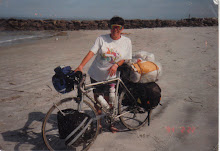
While upgrading through a series of light road bikes, I joined group rides, large benefit rides, and organized a recreational bicycling club in my town. Gingerly, I started riding a mountain bike. A heavy-duty touring bike took me on several multiday tours and eventually a solo, self-contained cross-country trip.
Okay, now I'm in a different state, different atmosphere, different age. I have cut back to bicycle commuting and one organized ride per year. I find the recreational club in this town somewhat daunting. I still hold out hope for another cross-country expedition, maybe north to south this time.
My coworkers at my first "professional" job probably thought of me as that "girl on the bicycle," but were too polite to say so aloud. Similarly, a motorcycle-riding female computer scientist was defined as "the woman who rides a motorcycle."
With the higher profile and popularity of the Tour de France and bicycling's entry in the Summer Olympics in the 1980s, bicycling became more mainstream. Finally, I was, well, maybe quasi cool.
Then, a new Army general and avid cyclist came to lead the military base adjacent to the town. Bicycling became cool, very cool, and trendy, and chic and the "it" thing to do. Especially for gung-ho young military officers. I continued to draft behind the virtual peleton of cycling popularity, commuting to work (20 miles round trip at an average 12 mph), participating in recreational rides. The fun and convivial local bicycle club called itself the "ride to eat" club, with rides punctuated midway by a breakfast stop.
It's interesting to observe the viral spread of cycling popularity. At this point, I was a full-fledged bikie, but a woman from work, encouraged by another dyed-in-the-wool cyclist, amazed me by riding about 20 miles daily of unrelenting uphill from her home by the river to our work site on the flank of a mountain. Without a go-fast bicycle, without purpose-built cycling clothing, and perhaps without a clue that she was peforming an amazing physical feat on a daily basis.
While upgrading through a series of light road bikes, I joined group rides, large benefit rides, and organized a recreational bicycling club in my town. Gingerly, I started riding a mountain bike. A heavy-duty touring bike took me on several multiday tours and eventually a solo, self-contained cross-country trip.
Okay, now I'm in a different state, different atmosphere, different age. I have cut back to bicycle commuting and one organized ride per year. I find the recreational club in this town somewhat daunting. I still hold out hope for another cross-country expedition, maybe north to south this time.
Sunday, May 18, 2008
Working 101
 Last month, the man who took a chance on a neophyte wannabe technical writer 28 years ago in Sierra Vista, Arizona, swung by the southeast Texas area with his wife in their recreational vehicle. Richard and Margie are full-time RVers, having sold their homestead and equestrian ranch in favor of criss-crossing the country in an RV towing a wood-carving shop, working at bed-and-breakfast one season, spending the summer at their secluded acreage the next.
Me, circa 1986 (left) in my badge photo. Richard today, in his RV (right).
They looked the same, truly. Richard, prematurely gray even back then, now white-haired, but with the same jovial sense of humor, same good heart. Margie, a horse wrangler, looking fit and trim and relaxed.
Reflecting about the three years I worked for Richard reminded me of the Mark Twain quotation: "When I was 16, I was shocked at how little my father knew; when I was 22, I was amazed how much he had learned in six years." At 22, I'm certain I was a difficult, opinionated, undiplomatic, awkward, unpoised recent college graduate. Like Twain's 16-year-old self, I thought perhaps not that I knew it all, but certainly more than the people I worked with. In retrospect, I would not have wanted to work for myself. I thought I knew a lot; I really knew nothing. I had no idea the difficulty of managing a technical writing section. Richard not only put up with a lot of stress induced by me—and several other of my motley bunch of coworkers—but, to his credit, held no hard feelings.
Thanks to the start Richard gave me more than a quarter-century ago, I've made all or part of my living as a technical writer since then. But even more important, after years in the graduate school of hard knocks, I view Richard's instruction in Working 101 as one of the best fundamental courses I have taken.
They looked the same, truly. Richard, prematurely gray even back then, now white-haired, but with the same jovial sense of humor, same good heart. Margie, a horse wrangler, looking fit and trim and relaxed.
Reflecting about the three years I worked for Richard reminded me of the Mark Twain quotation: "When I was 16, I was shocked at how little my father knew; when I was 22, I was amazed how much he had learned in six years." At 22, I'm certain I was a difficult, opinionated, undiplomatic, awkward, unpoised recent college graduate. Like Twain's 16-year-old self, I thought perhaps not that I knew it all, but certainly more than the people I worked with. In retrospect, I would not have wanted to work for myself. I thought I knew a lot; I really knew nothing. I had no idea the difficulty of managing a technical writing section. Richard not only put up with a lot of stress induced by me—and several other of my motley bunch of coworkers—but, to his credit, held no hard feelings.
Thanks to the start Richard gave me more than a quarter-century ago, I've made all or part of my living as a technical writer since then. But even more important, after years in the graduate school of hard knocks, I view Richard's instruction in Working 101 as one of the best fundamental courses I have taken.
Friday, May 16, 2008
Original recipe for blackened tilapia Tajin
Tajin Fruit Seasoning, salsa en polvo. Powdered salsa. A seasoning for all seasons. It is intended to be sprinkled on fruit, but its piquant flavor is has much more potential.
As unlikely as it sounds, try--just try!--Tajin fruit seasoning sprinkled on strawberry ice cream. A synergistically phenomenal contrast of flavors.
Now, an original recipe from the kitchen of Waitress from Mensa:
Blackened Tilapia Tajin
4 tilapia fillets
3/4 cup flour
3 tablespoons Tajin fruit seasoning
1 tablespoon Italian seasoning
pinch nutmeg
1/2 teaspoon salt
1/2 teaspoon pepper
enough oil for pan frying
Toss flour, Tajin fruit seasoning, Italian seasoning, nutmeg, salt, and pepper with a fork.
Dredge tilapia fillets, both sides, in flour mixture. Fry in hot oil in a skillet, both sides, until fish flakes easily with fork.
Lime + chile: The taste will explode on your tongue; not hot, just flavorful.
As unlikely as it sounds, try--just try!--Tajin fruit seasoning sprinkled on strawberry ice cream. A synergistically phenomenal contrast of flavors.
Now, an original recipe from the kitchen of Waitress from Mensa:
Blackened Tilapia Tajin
4 tilapia fillets
3/4 cup flour
3 tablespoons Tajin fruit seasoning
1 tablespoon Italian seasoning
pinch nutmeg
1/2 teaspoon salt
1/2 teaspoon pepper
enough oil for pan frying
Toss flour, Tajin fruit seasoning, Italian seasoning, nutmeg, salt, and pepper with a fork.
Dredge tilapia fillets, both sides, in flour mixture. Fry in hot oil in a skillet, both sides, until fish flakes easily with fork.
Lime + chile: The taste will explode on your tongue; not hot, just flavorful.
Thursday, May 1, 2008
Breakin' up is a big to-do

My boyfriend, a wiry electrian (pun unintended), ended our our four-year relationship to pursue the fourth love of his life more than two years ago. (The first three partners did not work out.) Never could I have imagined that this decent, kind, forgiving, intelligent, analytical, and truthful man would treat me with such callousness. In that stationary moment, he became a stranger to me, full of lies and deceit and meanness. It was a messy thing, and he did not handle it well. Maybe I did not either.
Ultimately it is for the best, but my fundamental trust in my own perception of people is irreparably shaken.
Eventually, as one does, I came to terms with it, and moved on. In retrospect, it all makes sense now, but, of course, while in the relationship, in the moment, the signs are invisible.
Although marriage was never in the cards for us (in other words, in my tongue-in-cheek description, the relationship was not terminal, as in terminating in a marriage), he was the best and most respected of any beau in my 33 years of adult singlehood.
At this age, I feel relieved of the burden of worrying about marriage, or the fact that I've never been married. This is what it is. While in my earlier 30s, a dear friend said, "You might just be one of those people destined never to marry." Back then, I held out hope, but now I'm more "que sera" about it. (Thanks, Doris Day.)
Whenever I meet a lifelong bachelor of a certain age, though, I wonder what is wrong with him. But it does not occur to me that other people might be, understandably, raising the same questions about me. And are they right to wonder?
Even Jerry Seinfeld, before he was married, likened the idea of marriage to someone choosing a car, but with the imprimatur that you have to drive this one car for the rest of your life. Seinfeld is now married—to a possibly plagiarizing cookbook author—with whom he has three children. Of marriage, and alluding to the high divorce rate, someone wrote something to the effect that marriage was the triumph of hope prevailing over all rational thought and experience. We still do it, though.
Subscribe to:
Posts (Atom)