Tuesday, April 21, 2009

Wedding follies and foibles


Despite the best fretted-over plans, something always goes awry at a wedding: the mistakes are what makes the wedding memorable.

This past weekend my dear friend and her fiance were married in a lovely garden chapel in central Texas. It wedding sufficiently simple and well planned to be enjoyed even by the wedding party and families of the bride and groom.

The afternoon, the two precious and very quiet five-year-old flower girls broke away from racing the snails found in the gardens outside the chapel to participate in the rehearsal. With empty baskets, one mimicked the motions of gracefully tossing petals on the aisle. All set.

Fast-forward to the wedding. As maid of honor, I walked down the aisle first, followed by the ring bearer, who executed his right-angle turn toward the best man with military precision.

From my vantage point at the head of the aisle, I watched as one flower girl vigorously and conscientously pelted unsuspecting guests on her side of the aisle with fistfuls of petals, catching most of the guests by surprise. It makes me smile every time I think about it, and ten years from today, the flower girl with the powerful backhand will be what I remember.

Sunday, April 5, 2009

Print Journalism RIP


My college major was journalism. I was set on becoming a newspaper reporter long before Woodward and Bernstein's All the President's Men shunted hordes of college freshman, who would otherwise have become accountants and English teachers, into journalism schools.

One offhand statement by one of my professors at Northern Arizona University, either Dr. Bert Bostrom or Dr. Dal Herring, stuck with me first for its absurdity, and later for its staggeringly accurate prescience.

One of these professors said that in a few years, we would read our newspapers on a monitor in our home, printing out the articles that interested us. It would be this mysterious force, this new ways of reading the news, not television newcasts, that would sound the death knell for newspapers.

The time was the late 70s. No internet, no personal computers at the time. I could not even conceive of such a thing.

Fast forward to 2009. The revered Seattle Post-Intelligencer is shutting down the presses after 143 years of publishing; it will publish only an on-line edition.

The equally respected Detroit Free Press is cutting back to only three days of home delivery.

Even the venerable New York Times laid off 100 staff persons last week.

Media pundit Marshall McLuhan said, "People don't actually read newspapers. They step into them every morning like a hot bath."

I understand why it is necessary, and, of course, the wastefulness of natural resources on so many levels of the home-delivered paper, but still I'm sad to see the decline of this institution of the fourth estate.

To mangle quotations from Winston Churchill and FDR: "The only thing we have to fear is change itself."

Saturday, March 28, 2009

The Gym: Intense and purpose

Attribution for the title of this post goes to a gym in downtown Bisbee, Arizona, whose name is perhaps the best-ever play on words: The Intense and Purpose Gym.

Seldom does anything live up to its sales pitch.

Gold's Gym, however, is a welcome exception. About a decade ago, Gold's Gym established an outpost in Bryan, Texas, about a half-mile from my house. Ten or twelve years ago, Gold's offered a very attractive annual membership for charter members. Being a bit wary of the Venice, California, Muscle Beach reputation, I hesitated. Although I was in fairly good condition from cycling, and I had been a regular at gym in another state, I was wary of the meat market atmosphere at some gyms.

Could a middle-aged, overweight, unfashionable female feel comfortable in such a place? I was skeptical. But when two co-workers 10 years my senior joined, I overcame my shyness and joined. It's been fabulous.

The muscle-bound young man punctuated his pitch full of superlatives about the gym with references to his own impressive weight-training routine, both of which I discounted. He glossed over the group exercise classes and gave short shrift to the weight-training machines, both of which are the mainstays of my fitness program.

With a black/white/gray color scheme, the gym opened a few weeks later with what seemed at the time a wondrous variety of machines and a palette of group exercise classes. I loved it. The classes were expertly taught by professional, motivated instructors. Everything started on time. Although I was an experienced cyclist, the beginning group cycling class was, well more than a challenge, but eventually I worked my way into condition.

I progressed on weight training and saw immediate results. I loved the choreographed step aerobics classes.

Eventually, a sparkling gym was built in College Station, about four miles away. The Bryan gym was demolished and a gym rivaling its College Station sister was built its place, with a rubberized floor, an block-long avenue of aerobic exercise machines, four times the number of weight-training machines of the original, an airy aerobics room, and, of course, the free weights.

Starbuck's' CEO Howard Schultz talks about a "third place" other than work and home. For me, that is the gym, almost every morning.

Friday, March 20, 2009

Doing the pornographers' bidding

The title of this post either turns one off or captures the attention, right?

In 2004, while I was helping his mom with her computer, the son of a work acquaintance copied my credit card numbers and, I realized later, stole a check from my checkbook from my purse.

An on-line vendor of high-end athletic equipment called that evening to verify that I had indeed placed an order for several hundred dollars' worth of high-end basketball apparel when they noted a discrepancy between shipping and billing addresses. Thank goodness. I realize in a flash what had happened and cancelled my credit cards.

A few days later, several charges for membership to Internet pornography sites showed up on my checking account.

I knew, of course, it was the work of this person, as the house was filled with basketball memorabilia, and my friend's computer was choked with pornography, which would pop up randomly while we worked.

I reported the theft to the police. I called the third-party company who billed for the pornographers. The police were magnificent; the billing company in Austin, Texas, was abysmal, to put it charitably.

After confiscating the computer, a police technician determined through electronic forensic tests that the transaction times and amounts matched those in my checking account.

The first billing company customer service rep, Stacia, helpfully agreed to credit my accounts, and I should see the credit "in four to ten days." (That uncertain time frame should have been my first hint of trouble brewing.) Of course, the charges were remained, so again, I called and this time spoke to a less helpful customer "service" representative.

She insisted, with some hostility, that I was to seek recourse from the perpetrator, although she was aware that the transactions were under investigation by two separate police departments (my city and that to which the goods were to be shipped). The interaction finished with: "I know Stacia, and I know she would never say anything like that." She punctuated her accusation of me as a liar by hanging up.

This was a time of my life in which $90 would have made the difference between making it to the end of the month or bouncing a check. I bought nothing except the very minimum amount of food, and all produce was red-banded. Even a cup of coffee from a convenience market was deemed an unnecessary luxury. I walked or bicycled everywhere. Of course, I was unable to afford Tamoxifen (even from Canada) to treat the breast cancer I was diagnosed with two years before. It was a very lean and scary time.

I sent a certified letter with all the facts to the president of the company. No response.

In a desperate attempt to get out of the nonproductive customer service loop, I called the sales director, and was directed to a self-described "more seasoned" customer service rep.

And she was. She listened patiently while I explained the situation, said that the hostile rep had been dealt with properly, and credited my account. If there was an art to customer service, she was good at it. She knew how to "handle" difficult customers. She could have credited my account, and I could have remained angry; however, but her manner was professional and courteous and I was mollified.

This occurred in a time of vigorous economy. I asked, "Why is someone with your professionalism and excellent customer service skills doing the bidding of an Internet pornographers?" The question was rhetorical, meant as a compliment, and she understood.

In time, the man, who was on probation at the time of this episode, was brought to justice, and was forced by the court to make retribution.

The saga has a coda. Four years after the resolution of this problem, this gem of a B2B company again billed my checking account for the cost of the same Internet pornography. Yet another certified letter to the president went ignored. Another good customer service rep credited my account, but was unable to explain why, four years after the fact, my account was even on their books, much less being dunned for an illegitimate charge. Better Business Bureau contacted the company, but eventually reported the case as being resolved.

Thursday, March 19, 2009

Bicycle commuting

In the early 80s, I started making the 1.5-mile one-way commute to work on an 30-year-old internal-hub three-speed bicycle wearing no helmet, and in my regular dress clothes and shoes.

A few years later, I fell in with the cycling crowd and upgraded to a very nice Motobecane touring machine, adding racks an panniers to carry my dress clothes and grooming items. I took a job eight (uphill) miles from home and looked forward to my daily commute. I appended some steep, short hill climbs to my evening commute, and changed to a more scenic 10-mile morning commute. Of course, by then I was wearing purpose-built bicycle clothing and shoes. Many of my co-workers commuted by bicycle, including a "non-bikie" woman who rode an unrelenting uphill for 1.5 hours to get to work on a relatively heavy bicycle. Kept my 10-mile commute in perspective.

At that point in my life, I traveled almost everywhere by bicycle: grocery shopping, visiting friends, trips to the coffee and yarn shops, and, of course trips to the gym.

Now I live about 2.5 miles from work, and ride a downtube folding bicycle to work. My idea was to fold the bicycle, slip it into its carry bag, and hide it in my closet instead of leaving my trusted steed to the tender mercies of the bike rack. That did not work out, but I still love commuting by bicycle, made even more sweet by the fact that commuting is the only type of riding I do.
Bicycle commuting is easier than most people think. It is easy to carry clothing and personal items in a backpack. Although commuters may need to find an alternative to their usual main arterial route to work, making the trip by bicycle sometimes take less time. For me, the 2.5-mile commute takes me right to the door of my building, saving me the 7-minute trek from my parking lot. The total time in door-to-door commute is equal. Of course, I need to arrive a bit early to clean up, change, apply make-up, and undo the effects of helmet hair, but it is all worth it.

Saturday, March 7, 2009

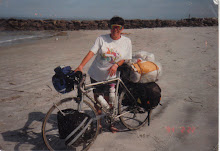
Bicycle touring

I remember waking up on a 7th or 8th birthday morning as a to a white and blue one-speed coaster brake bicycle. It became my magic carpet.

But once I learned that one could combine backpacking with bicycling, I knew self-contained bicycle touring was for me. I just knew it. I loved the efficiency that that the mode of transportation becomes the recreation becomes the the journey. I loved the self-contained-ness of it. It was all so compact and adventurous.

Often, I rode organized century or metric century (100- or 62-milers, respectively) and commuted to work by bicycle. But I longed to just follow my front wheel and explore America at 12 miles per hour. In my 20s, I fell in with a recreational bicycle group in Sierra Vista, Arizona, and just loved it. Small breakout groups took two- and three-day tours, some self-contained, some sagged. (SAG = support and gear).

Eventually, longer self-contained tours were on the itinerary; first were short tours to desert campgrounds in southeast Arizona. Loved it! Next was a multi-state trip from New Orleans to Cocoa Beach, Florida, with two guys I met via the Companions Wanted column in Adventure Cycling. Although my front wheel experienced and unknown mechanical failure, dealing me into a face plant on the pavement, one broken and three loose teeth (yes, eating was a problem after that), a hole in my upper lip, an 200-watt shiner, and some face road rash, I soldiered on. My one companion and I (the other abandoned the trip) crossed the Florida peninsula in one eyes-to-the-road day.

A tour through northern Sonora, Mexico, followed with beer truck drivers at a warehouse walking en masse to give us standing ovation for ascending and descending a mountain pass. Mexican drivers are fabulously polite on the road, even the truck drivers.

Of course, all of this culminated in a solo, self-contained cross-country tour, roughly following the Southern Tier maps from Adventure Cycling. I loved almost every minute, and found following my front wheel an amazingly liberating and enlightening experience. I camped in campgrounds mostly, met all types of people, sampled most types of food, although shied away from meat, except for a boudin in Cajun country. This country looks a lot different from the perspective of 12 miles per hour versus 70. Other person's tour experiences can be read at the most excellent site, Crazy Guy on a Bike. Much later, I published an essay in the Houston Chronicle on one night memorable for its subtlety and connection.

Now my cycling is mostly limited to bicycle commuting to work, covered in my next post.

Sunday, January 11, 2009

DHL shipping service as an economic indicator

DHL, the shipping company.

For reasons I can’t explain, the cheerful yellow DHL delivery trucks driving up and down University Drive seemed to signify a bustling economy and a beacon of constancy. DHL was an integral part of the “global village,” as those trucks seemingly delivered to even the remotest outpost. In German, DHL is (or maybe was) the Deutscheposte contractor, essentially the hired gun of the federal postal service.

(I never stopped marveling that packages from Wuhan or X’ian China, were delivered in three days by DHL, while a package to Seattle took a week (and then some) via first class mail US Postal Service.)

Battered by high fuel prices and then by the recession, DHL has essentially ceased domestic operations in the United States. The drop boxes are gone from the academic buildings. No longer can I count on looking out my office window and be almost guaranteed to see a yellow van driving purposefully to its next stop. Last week in my neighborhood, I glimpsed a characteristic sunny-looking van without the red DHL logo or characteristc markings. It was only when I drew close and saw the yellow-and-red jacketed driver that I could verify it was DHL.

It turns out the yellow DHL trucks were actually the yellow miners' canaries of the economy.

Friday, December 12, 2008

Snow in the Brazos Valley

Very early the previous morning of December 10, 2008, the Brazos Valley was blanketed by a sleet storm. Then, that afteroon, snow, in big accumulations of flakes, fell on the Brazos Valley—and even upon Houston, Texas. Most students at Texas A&M University had never seen snow on the campus. Many snowmen lived for a day, until temperatures in the 60s took their toll. Cars (see photo) drove around with miniature snowman mascots.


In photo at right: my friend, the bride-to-be (right), and me, at 6:00 p.m. Wednesday, with the Civil Engineering–TTI, H.R. Bright, and Engineering-Physics Buidings in the background at Texas A&M University.

Students—even graduate students—frolicked in the snow.

Sunday, December 7, 2008

From grime to glam: Brazos Valley Decorative Center


Brazos Valley Decorative Center, south view

A midcentury building at the corner of 29 St. and Main in downtown Bryan for years housed a grimy tractor dealership. Nothing wrong with tractors; the building just seemed utilitarian rather than remarkable. Remarkably, though, it was designed by Raymond Loewy, the father of industrial design and the designer responsible for the Shell Oil Co. logo, a Greyhound bus fleet logo, NASA spacecraft interiors, the U.S. Mail eagle logo, and the Studebaker car.

Ambrose Furniture Works saw the potential in the building and, with the help of a Downtown Improvement Grant, turned the building into the Brazos Valley Decorative Center. The interior is a sumptuous feast of fabric, color, and texture. The service bays are converted to rental space for other design-focused businesses.

"Originally an International Harvester Service Center designed by Loewy’s firm and built around 1947, the building is being renovated and due to open in mid-July. This time, it will not provide space to service and sell tractors; instead the building will pay homage to its creator as a place for design. Ambrose Furniture Works has developed the Brazos Valley Decorative Center to house their establishment as well as provide space for other design vendors to create a comprehensive home décor center for local interior designers and do-it-yourselfers alike." (aboutTown Press, July 1, 2008)

“It is an excellent example of post-war modern design. It has high bays, a large footprint, and parking.” said Randall Spradley of Astin Partners, one of the business entities taking a leading role in downtown, quoted in abouTown Press.


Brazos Valley Decoratve Center, north view

Downtown Bryan, Texas, Art Deco


A decade ago, historic downtown Bryan, Texas, was a pastiche of excellent locally owned restaurants, an intriguing international import shop, an unfinished furniture store, several thrift shops, a homeless mission, but, more notably, a number of abandoned main-street style storefronts, some roofless, some boarded-up, others without even the dignity of plywood covering the gaping windows.


Today, downtown Bryan is a destination, a vibrant city center, with a monthly Friday evening gallery tour and live music attracting throngs of citizens and tourists. The import shot relocated to a gorgeous storefront, several new, and some upscale, restaurants have opened, there's a massage therapy studio, and a scattering of antique shops sitting cozily beside some very high-tech neighbors.


A bit longer than a decade ago, the City of Bryan procured a community block grant to refurbish the Hotel LaSalle, which converted from a derelict hulk into a charming inn.

A group of citizens worked hard to transform the old firehouse into the Children's Museum of the Brazos Valley. Old Bryan Marketplace hosted a tea room along with an Texas-eclectic antiques collection.

(The concrete reliefs are art deco details are from the First State Bank and Trust Building, downtown Bryan, Texas.)


I am crazy about art deco, and downtown Bryan offers some great examples. The tallest building in downtown and the most flamboyantly art deco is Varisco Building. Bottomland cotton farmer Biaggio Varisco, an Italian immigrant, so loved his adopted home that he changed his first name to Brazos, after the county and its river (Brazos de Dios). In some essential way, the Varisco Building resembles the Empire State Building in this photo taken at Empire State Building: 5th Avenue & 28th Street.

The Varisco Building now houses a Tier IV data center, offering data storage and disaster recovery services to corporations, mainly in the Houston area. Fibertown grew out of the location of a fiber trunk routed through downtown Bryan. Fibertown offers bandwidth management, "an advanced data center with backup power, a high-speed managed network, high-capability services, and high-security biometric and RF building controls." (aboutTown Press, October 2007). The Fibertown "campus" has expanded five historic downtown buildings.


Main Street, downtown Bryan, looking north, with the Varisco Building in the distance.